
Let’s take a ride through the essential stops to becoming a confident Python programmer.
Stop-1 : Getting comfortable with the basics of coding.
Every journey begins with your first step, and in coding or learning Python, it is essential to understand the building blocks and why they are behind them.
At this stop, you need to explore
- What is coding?
- What is programming?
- What is Python, and where is it used?
- Why Python, and which company uses Python?
- Writing your first code in Python
- Understand variables, data types, and simple math operations.
- Learn how users can interact with Python without coding knowledge.
- Printing the output on the screen
					name = input("What's your name? ")
print("Welcome to Python, " + name + "!")
This phase is the beginning phase, focusing on syntax (the way of writing code) and how Python works—no pressure, take your time and consume as many videos as you can.
Stop-2 : Playing with Loops and conditional statement
It’s time to start incorporating logic and flow into your programs after you’ve mastered the fundamentals of Python.
This is a very important step; most programmers stop at this point, but you don’t have to perform exactly what is stated here.
You must study
- Conditional statements, such as if, elif, and else statements, at this point.
- Comparative and logical operators
- Loops: While loops and for loops
- Creating simple applications such as text-based games, calculators, and patterns
At this point, solving patterns and numerical patterns will boost your self-esteem and produce dopamine.
You would benefit by solving patterns and answering the same questions.
Here are 5 challenges that you should try
Mini Challenge 1: The Pattern Pyramid (Inverted + Centered)
Task: Print a centered pyramid pattern made of * based on user input.
* * *
* *
*
Mini Challenge 2: Magic Number Game with Limited Attempts
Task: Let the user guess a secret number between 1–100.
- Give hints: “Too high” or “Too low”
- Only 5 attempts allowed
- Reveal answer at the end if failed
Mini Challenge 3: Detect Palindrome Numbers
Task: Ask user for a number and check if it’s a palindrome (e.g., 121, 444).
🧠 Logic Focus:
- Number manipulation
- String slicing or math reversal
- Decision-making
Mini Challenge 4: FizzBuzz with a Twist
Task: Print numbers from 1 to 50 with these rules:
- Multiples of 3 = “Fizz”
- Multiples of 5 = “Buzz”
- Multiples of both = “FizzBuzz”
- Numbers containing ‘3’ = “Lucky”
Mini Challenge 5: Sum of Digits Until Single Digit
- Task:
Take any number from user (e.g., 874), keep adding its digits until a single-digit number is reached. - Example: 874 → 8+7+4 = 19 → 1+9 = 10 → 1+0 = 1
Stop 3: Using Dictionaries, Lists, and Functions
You now have a foundational understanding and practical experience with loop logic.
It’s time to step up your coding skills and investigate the realm of data reuse and absolutely organized data organization.
You will become proficient in :
Writing and invoking functions at this point.
Combining loops and lists.
Overview of lists, tuples, and dictionaries.
Making basic applications such as a contact book, a quiz, or a to-do list.
Stop 4: Developing meaningful projects
It’s time to start creating actual projects that you can show off in your portfolio, share with friends, or enter into competitions.
Your vision can become a reality.
Here are some suggestions for you to consider:
- Using an API, the weather app
- A BMI calculator
- Random word generator for stories
- An expense tracker that uses input and lists
Choose the project first, then study :
- File management and how to use
- Python libraries like math, datetime, and random.
- The fundamentals of utilizing data and external APIs
This is where logic and creativity collide, and the outcome is thrilling. Set aside time to ensure your project is operational and to offer it a complete view and loop.
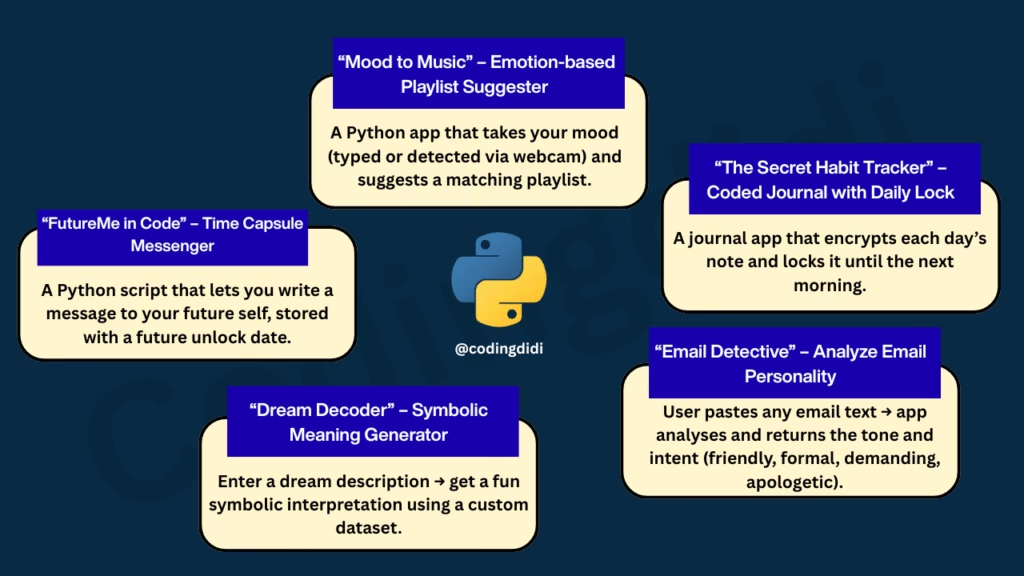
Stop 5: Showing off your prowess
You’ve made great progress by this point; now is the time to hone your abilities and showcase them for increased credibility.
This is what you will do.
- Your online coding portfolio, Github, is where you should upload your creations.
- Make a brief section on your coding abilities for your resume.
- Get certificates for finishing mini-courses and challenges.
- Complete Python challenges on platforms such as Codingdidi’s Learner Hub or HackerRank.
Building confidence and getting ready for real-world opportunities—like internships, freelance work, or coding contests—are the main goals of this stop.